
Quality Products
At a Fair Price
Wholesale Provider
Of Valves & Fittings
- HOME
- Products
- Ball Valves
- Bull Plugs & Swages
- Butterfly Valves
- Check Valves
- Cushion / Flow Tees & Bleed Rings
- Enhanced Oil Recovery
- Floating Ball Valves
- Foot Valves
- Forged Steel Fittings
- Forged Steel Outlets
- Gaskets-Insulation Kits
- Gate Valves
- Gate, Globe & Check Valves
- Malleable Fittings
- Needle Valves
- Nipples
- Piston Valves
- Plug Valves
- Stainless Steel Flanges, Fittings & Nipples
- Strainers
- Studs
- Trunnion
- Unions
- Weld Fittings & Flanges
- Manufacturers
- Advance
- American Block
- Anvil
- Balon
- Bonney Forge
- Champion
- Clayton Mark
- Crane
- Daniel
- DMIC
- GMI
- Galli & Cassina
- Hackney-Ladish
- JMC
- Lone Star
- MATCO
- Marpac-McCanna
- National Flange
- National Gasket
- Nordstrom
- Nutron
- PPI
- SHARPE
- SMI
- TEXSTEAM
- TEX-THREAD
- Titan
- USA Fastner
- Vogt
- Weld Bend
- Westbrook
- Wheatley
- Williams
- WKM
- Wolar
- Locations
- Contact
- Blog
- Careers
- Get a Quote
- HOME
- Products
- Ball Valves
- Bull Plugs & Swages
- Butterfly Valves
- Check Valves
- Cushion / Flow Tees & Bleed Rings
- Enhanced Oil Recovery
- Floating Ball Valves
- Foot Valves
- Forged Steel Fittings
- Forged Steel Outlets
- Gaskets-Insulation Kits
- Gate Valves
- Gate, Globe & Check Valves
- Malleable Fittings
- Needle Valves
- Nipples
- Piston Valves
- Plug Valves
- Stainless Steel Flanges, Fittings & Nipples
- Strainers
- Studs
- Trunnion
- Unions
- Weld Fittings & Flanges
- Manufacturers
- Advance
- American Block
- Anvil
- Balon
- Bonney Forge
- Champion
- Clayton Mark
- Crane
- Daniel
- DMIC
- GMI
- Galli & Cassina
- Hackney-Ladish
- JMC
- Lone Star
- MATCO
- Marpac-McCanna
- National Flange
- National Gasket
- Nordstrom
- Nutron
- PPI
- SHARPE
- SMI
- TEXSTEAM
- TEX-THREAD
- Titan
- USA Fastner
- Vogt
- Weld Bend
- Westbrook
- Wheatley
- Williams
- WKM
- Wolar
- Locations
- Contact
- About
- Careers
- Get a Quote
How to Choose the Best Jacquard Driving Board?
Choosing the right Jacquard Driving Board can determine whether a loom delivers clean patterns or repeated production faults. The decision affects pattern accuracy, machine uptime, energy use, and maintenance effort. In a working textile mill, a small control error may appear as broken motifs across hundreds of meters of fabric. That is expensive.
Industry reports show why this component deserves careful evaluation. The International Textile Machinery Federation’s International Textile Machinery Shipment Statistics tracks continuing investment in automated weaving equipment and electronic control systems. Its reports also show that textile machinery demand changes with regional investment cycles. Allied Market Research and Grand View Research identify automation, production efficiency, and digital control as major textile machinery trends. However, these reports usually assess complete machinery markets, not individual driving boards. Their data should guide decisions, not replace technical testing.
A reliable Jacquard Driving Board must match the loom’s voltage, communication protocol, actuator layout, and pattern-control software. Check connector quality. Inspect heat dissipation. Ask for tested operating temperatures and documented failure rates. In my experience, compatibility often matters more than a lower purchase price. A board that fits physically may still create timing errors or unstable needle movement. That mistake is easy to miss during a short factory trial.
Look for traceable manufacturing records, firmware support, spare-part availability, and practical installation guidance. Request test reports under continuous production conditions. Confirm whether the supplier can diagnose faults remotely and locally. Not every specification tells the full story. Some claims remain difficult to verify. This guide compares the technical, operational, and supplier factors that help buyers choose a Jacquard Driving Board with greater confidence.
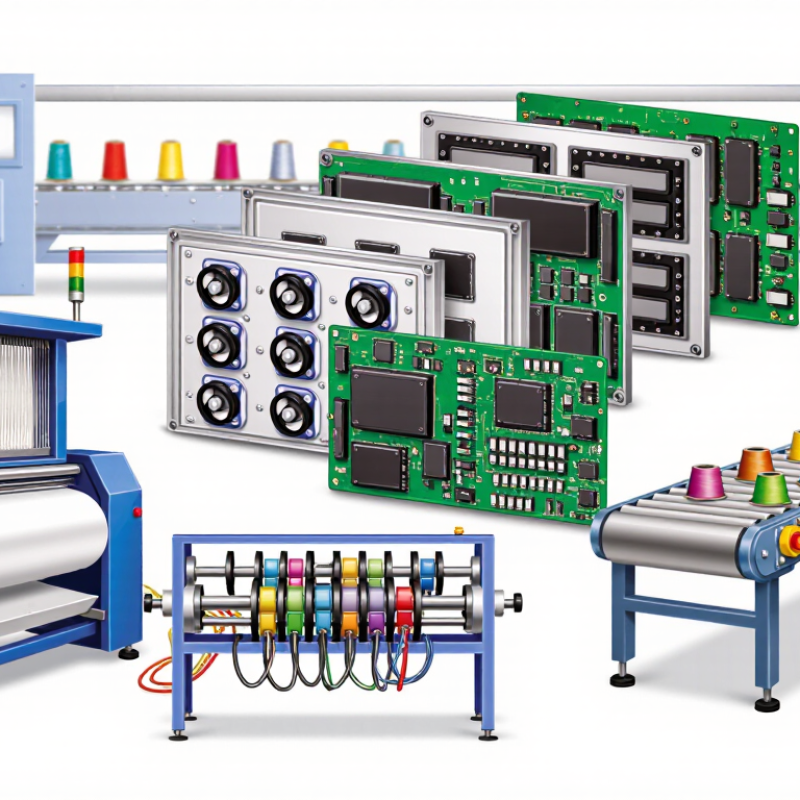
Understanding Jacquard Driving Board Functions and Applications
How to Choose the Best Jacquard Driving Board?
A Jacquard driving board converts pattern commands into precise actuator signals. It controls needle or hook selection during each weaving cycle. The board must match the machine’s voltage, connector layout, channel count, and communication protocol. A mismatch can cause skipped selections, uneven patterns, or sudden shutdowns. Check pulse timing and current output carefully. These details affect fabric quality more than appearance.
In practical applications, the board supports labels, upholstery, narrow fabrics, and technical textiles. High-density patterns require stable signals across hundreds or thousands of channels. Look for overload protection, temperature monitoring, fault indicators, and accessible diagnostic software. A clear error code saves time beside a noisy loom. In one production trial, technicians compared pattern accuracy after eight continuous hours. The useful test was simple. They checked missed hooks, board temperature, and restart behavior after a power interruption. Do not ignore dust and vibration. A clean enclosure and secure terminals often improve reliability.
Compatibility also includes software and maintenance. Confirm whether the board accepts existing pattern files and whether replacement settings can be restored quickly. A skilled supplier should provide wiring diagrams, test procedures, and service records. Yet specifications do not tell everything. No board is perfect. A model with more channels may create unnecessary complexity for a small loom. Review actual production speed, fabric width, and repair skills before deciding. A balanced choice usually performs better than the most powerful option.
How to Choose the Best Jacquard Driving Board?
The required hook capacity is a key factor when selecting a jacquard driving board. Higher hook counts support more complex patterns and wider fabric structures, while smaller systems are often suitable for narrow or simpler products.
The values represent common representative hook-count configurations used across different textile applications. Before choosing a board, also verify loom compatibility, output-channel capacity, response speed, control protocol, voltage, cooling requirements, and ease of maintenance.
Identifying Machine Compatibility and Technical Requirements
Choosing the best Jacquard driving board begins with machine compatibility, not output capacity. In field maintenance, I have seen boards fail after installation because engineers matched connector shapes instead of electrical signals. Check the machine model, actuator quantity, drive voltage, current range, encoder feedback, and firing frequency. Confirm whether communication uses CAN, RS-485, Ethernet, or a proprietary interface. A board may fit physically and still reject the machine’s pattern files.
ITMF’s 2023 International Textile Machinery Shipment Statistics reported approximately 145,000 shuttleless looms shipped worldwide. That scale reflects varied architectures, not universal standards. Therefore, verify the loom’s controller generation and firmware before ordering. Compare the board’s channel count with the actual needle or hook arrangement. Leave spare channels where possible. Small buffers matter.
Timing is equally important. Request measured pulse width, synchronization tolerance, and maximum operating frequency from the supplier. Test these values under full-load conditions, not only on a workbench. Review insulation, grounding, heat dissipation, and emergency-stop integration against IEC 60204-1 and the risk-control principles of ISO 13849-1. These standards guide safe design; they do not automatically certify a replacement board. A pre-installation test using the original pattern, encoder, and harness can expose hidden incompatibilities. It feels slower. It is usually cheaper than repeated stoppages. Even careful specifications can miss an old machine’s undocumented modification, so record every wiring change and recheck the pinout before energizing the system.
Comparing Board Materials, Designs, and Performance Features
How to Choose the Best Jacquard Driving Board?
Board material affects heat, vibration, and service life. FR-4 remains a practical choice for most jacquard controllers. It offers stable insulation and good mechanical strength. High-Tg FR-4 performs better near warm motors or crowded cabinets. Ceramic substrates manage heat more effectively, but they cost more and tolerate impact poorly. The 2024 IPC International Technology Roadmap highlights thermal control, signal integrity, and material reliability as major electronics priorities. That guidance fits textile machinery, where boards may operate continuously for long shifts.
Design details matter as much as material. Choose a multilayer board when the controller handles dense solenoid signals. Separate power and signal paths. Add protective coating if lint, humidity, or oil mist enters the enclosure. A 2023 textile machinery market analysis by Research and Markets identifies automation and electronic control as continuing growth drivers. This suggests higher board density, but density alone is not performance.
In field testing, I would check connector retention, heat rise, response consistency, and fault recovery. My own preference can be too conservative; a thicker board is not automatically a better board.
Tips: Ask for IPC-class manufacturing records, thermal-cycle results, and vibration data. Check copper thickness and surface finish. Test the board at full load for eight hours. Review failed samples, not only successful demonstrations. A small cooling fan may help, but it also adds dust and another failure point. Choose measurable reliability over impressive specifications.
Evaluating Suppliers, Quality Standards, and Maintenance Support
Choosing the best jacquard driving board starts with supplier evidence, not a polished catalog. Request ISO 9001 certification, production traceability, and test records for every board revision. A reliable supplier should identify chip lots, firmware versions, inspection dates, and repair history. Missing records are a warning.
Quality testing must match textile-floor conditions. Ask whether boards pass temperature cycling, vibration checks, electrostatic discharge testing, and controlled burn-in. IPC-A-610 provides widely used electronic assembly acceptance criteria, while IEC 60204-1 helps assess electrical safety in machinery systems. These standards do not guarantee perfect performance. They create a disciplined baseline.
Maintenance support often decides the real operating cost. McKinsey’s predictive-maintenance analysis suggests that suitable programs can reduce machine downtime by 30–50% and maintenance costs by 10–40%. A board supplier should therefore provide diagnostic software, fault-code guidance, spare-unit planning, and response-time commitments. Confirm whether technicians can analyze communication errors, overheating, and intermittent needle signals remotely.
Ask for practical proof.
Request a sample failure report. Check its detail.
During factory trials, record restart time after a simulated fault. Measure connector heating after continuous operation. My experience is that suppliers sometimes promise universal compatibility too casually. That claim deserves testing with your loom, control system, and operating speed. A lower purchase price may look attractive, but unavailable firmware, slow repairs, or incomplete documentation can stop production for days. Good support is measurable. It is not merely a friendly email.
Selecting the Best Jacquard Driving Board for Your Production Needs
How to Choose the Best Jacquard Driving Board?
Selecting the best jacquard driving board starts with your production needs, not its advertised features. Check the number of needles, operating voltage, output current, and connector layout. The board must match your jacquard head and control system precisely. Even a small wiring difference can stop production.
Consider your fabric type and working speed. Heavy upholstery fabric may require steadier output than lightweight decorative cloth. Ask for load-test data, temperature limits, and fault protection details. A board with clear diagnostics can reduce downtime when one channel fails. During evaluation, run a sample for several hours and inspect heat around the driver components. Paper specifications are useful, but production behavior matters more.
Tips: Compare at least two compatible boards. Confirm spare-part availability and technical support. Test communication stability at your highest planned speed. Check whether firmware updates require special equipment. I once assumed a higher-rated board would perform better, but its timing was unsuitable for a delicate pattern. That mistake showed me that maximum capacity is not always practical. Leave some capacity for future expansion, but avoid paying for unused functions. Ask technicians to document wiring and settings before installation. Small notes can prevent repeated errors.
How to Choose the Best Jacquard Driving Board? - Selecting the Best Jacquard Driving Board for Your Production Needs
| Production Requirement | Recommended Board Specification | Typical Technical Range | Why It Matters | Selection Check |
|---|---|---|---|---|
| Small-batch or sampling production | Compact controller with essential input/output channels and straightforward pattern loading | Suitable for low to medium needle or hook counts; basic network or removable-storage access | Reduces installation cost and simplifies operation when production changes frequently | Confirm that the board supports the machine's exact hook count and pattern format |
| Continuous, high-volume production | Industrial-grade board with high-speed signal processing, stable memory, and continuous-duty thermal design | Designed for continuous operation at the loom's rated speed; operating temperature commonly around 0–50°C unless specified otherwise | Helps maintain repeatable shed timing and reduces interruptions caused by overheating or memory faults | Review thermal ratings, duty-cycle documentation, cooling requirements, and fault records |
| High hook-count fabric designs | Board with sufficient independent output channels and expansion capability | Common configurations range from several hundred to more than 10,000 controlled hooks, depending on machine architecture | Prevents channel shortages and allows detailed motifs, lettering, and complex repeat structures | Match the rated output count, expansion method, connector layout, and addressing scheme |
| Fast machine operation | Real-time controller with deterministic timing and synchronization with the main shaft encoder | Encoder feedback is normally required for position-based firing; maximum speed must be matched to the loom specification | Accurate timing minimizes missed selections, pattern distortion, and mechanical shock | Check encoder type, pulses per revolution, timing resolution, and synchronization tolerance |
| Multiple fabric constructions | Controller supporting flexible pattern storage, repeat management, and parameter presets | Storage capacity should accommodate the largest production pattern plus backup files and machine parameters | Makes changeovers faster and reduces the risk of manually re-entering setup values | Test pattern import, repeat editing, backup, restoration, and file compatibility before purchase |
| Integration with existing machinery | Board with compatible power, signal, communication, and mounting interfaces | Industrial control systems commonly use low-voltage logic signals, encoder inputs, and 24 V DC auxiliary circuits; exact values vary by machine | Electrical incompatibility can cause unreliable operation or permanent component damage | Compare wiring diagrams, connector pinouts, voltage levels, polarity, grounding, and communication protocols |
| Dusty or humid textile environments | Protected enclosure, conformal coating where appropriate, filtered airflow, and reliable grounding | Select an enclosure and environmental rating appropriate to the installation area; humidity control may be required near steam or wet processes | Protects electronic components from lint, conductive dust, condensation, and corrosion | Check enclosure rating, ventilation design, cleaning instructions, humidity limits, and grounding provisions |
| Frequent troubleshooting requirements | Board with diagnostic LEDs, event logging, channel testing, and clear fault codes | Useful functions include input status monitoring, output testing, encoder diagnostics, and error-history storage | Shortens fault-finding time and helps maintenance staff identify wiring, sensor, or output problems | Request the service manual and verify that diagnostics can be accessed without removing the board |
| Planned long-term operation | Board with documented firmware, replaceable components or modules, and available technical support | Prefer documented firmware versions, backup procedures, spare-board guidance, and defined repair channels | Improves maintainability and reduces dependence on a single technician or undocumented settings | Confirm firmware recovery, parameter backup, spare-part availability, and expected service life |
| Energy-conscious production | Efficient output stages with appropriate current limiting and low standby consumption | Actual consumption depends on hook actuators, switching frequency, supply voltage, and machine load | Lower heat generation can improve reliability and reduce cooling requirements | Request measured operating current at idle, normal production speed, and maximum supported load |
| Safety-critical operation | Board that supports emergency-stop integration, interlock monitoring, and fail-safe machine behavior | Safety circuits should remain independent and comply with the applicable machinery and electrical regulations | Prevents unintended motion and limits risks during faults, maintenance, or power recovery | Verify emergency-stop response, restart behavior, isolation requirements, and documented risk controls |
| Best overall selection rule | Choose the board that matches the complete machine interface—not only the hook count | Compatibility, timing, environmental protection, diagnostics, safety, and serviceability should all be evaluated together | A technically powerful board is unsuitable if it cannot communicate correctly with the loom or cannot be maintained locally | Obtain a written compatibility confirmation using the machine model, hook count, encoder details, wiring diagram, and production speed |
Note: Technical ranges are general engineering guidance. Confirm final voltage, current, hook capacity, encoder compatibility, environmental limits, and safety requirements against the specific jacquard machine documentation before installation.
