How to Choose Butterfly Valves in 2026?
How to Choose Butterfly Valves in 2026? The answer starts with the process, not the product catalogue. A valve installed on a chilled-water line faces different demands than one handling abrasive slurry. Pressure, temperature, media chemistry, flow velocity, shutoff class, and maintenance access should guide every decision.
Market data shows why selection deserves closer attention. MarketsandMarkets estimates the global butterfly valve market will grow from approximately USD 9.8 billion in 2023 to USD 13.7 billion by 2028. Grand View Research also identifies steady expansion through 2030, driven by water infrastructure, energy, chemical processing, and industrial automation. These figures differ because research firms define markets differently. That limitation matters.
Peter Smith, co-author of the Valve Selection Handbook, states, “Valve selection depends on service conditions, not merely on pipe size.” It is a useful warning for 2026 buyers. A DN200 valve may fit the pipeline, yet its seat material could fail under high temperature. A poorly chosen actuator may also create slow, unreliable operation. Small details become expensive quickly.
This guide examines butterfly valves through practical engineering questions. Should the design use a resilient seat, high-performance offset disc, or triple-offset construction? Is wafer, lug, or flanged connection more suitable? What evidence supports the supplier’s torque data and lifecycle claims?
No selection method is perfect. I may still underestimate unusual operating conditions without verified site data. Therefore, this overview combines published market research, manufacturer documentation, and field-focused engineering judgment. Reliability begins with checking assumptions before ordering.
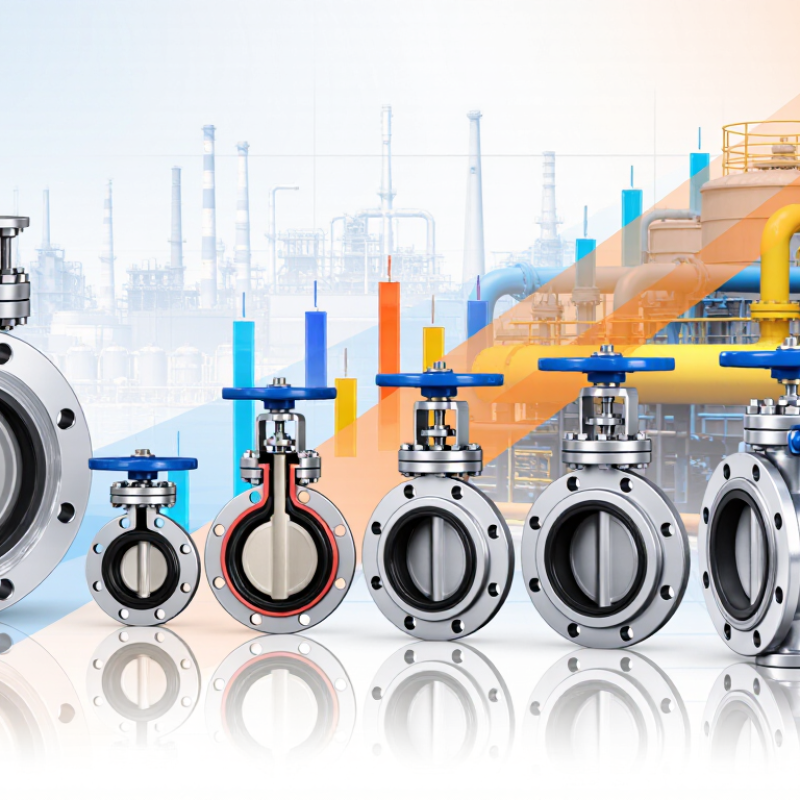
Butterfly Valve Basics and Operating Principles
Butterfly Valve Basics and Operating Principles
A butterfly valve controls flow with a circular disc mounted on a rotating stem. At 90 degrees, the disc turns from fully open to fully closed. Quarter-turn operation makes it compact and fast. The disc, however, remains inside the flow path. This can create pressure loss, especially near high velocities.
The seal usually relies on an elastomer seat or a metal arrangement. Seat material must match temperature, pressure, and fluid chemistry. Water service may tolerate resilient seating, while hot hydrocarbons require stricter material review. The valve body also needs suitable pressure and corrosion resistance. API 609 covers butterfly valve design requirements, while ISO 5211 helps coordinate valve and actuator mounting. These standards support consistency, not perfect selection.
The details matter.
MarketsandMarkets’ 2024 Industrial Valves Market report estimated the market at about USD 78.8 billion in 2023. It projects roughly USD 95.8 billion by 2028, showing continued demand for flow-control equipment. That growth does not make every butterfly valve suitable. A smaller valve may reduce purchase cost, but poor throttling can increase turbulence and seat wear. A larger valve may operate too close to its closed position, reducing control accuracy. Field engineers should check flow rate, pressure drop, temperature, shutoff class, and actuator torque together. A tidy specification sheet can still mislead. Real pipe alignment and operating cycles often expose the weakness.
Key Factors for Selecting a Butterfly Valve
How to Choose Butterfly Valves in 2026?
Selecting a butterfly valve starts with the process, not the catalogue. Identify the medium, pressure, temperature, flow direction, and cycling frequency. A valve for clean water may use a resilient seat, while abrasive slurry needs tougher lining and improved shaft protection. The 2024 UNESCO World Water Development Report notes that agriculture represents roughly 70% of global freshwater withdrawals.
That figure reinforces the need for efficient throttling and reliable isolation in irrigation systems.
Check the actual pipe diameter and flange standard. Small dimensional errors create expensive installation delays.
Operating torque deserves equal attention. Calculate breakaway torque, running torque, and safety margin under the worst temperature and pressure conditions. An actuator sized only for normal service can fail during shutdown.
For leakage verification, specify an accepted test class under ISO 5208 instead of using vague terms such as “tight shutoff.” API 609 remains a useful reference for wafer, lug, and double-flanged butterfly valve design.
Energy and water projects are also demanding longer service intervals; the International Energy Agency’s World Energy Outlook 2024 highlights continued investment in expanding and upgrading infrastructure.
That does not make every premium specification necessary. A neat selection matrix can still mislead. I would recheck chemical compatibility, seat wear, emergency positioning, and access for maintenance before approval.
Field experience often exposes assumptions that spreadsheets miss.
Matching Pressure, Temperature, and Media Requirements
How to Choose Butterfly Valves in 2026?
Matching pressure, temperature, and media requirements starts with the actual operating conditions, not the pipeline’s nominal size. In field inspections, I have seen valves selected for normal pressure while ignoring pump surges. That mistake can shorten service life quickly. Record working pressure, maximum pressure, vacuum conditions, and pressure fluctuations. Then compare them with the valve’s rated pressure at the expected temperature. Ratings often decrease as temperature rises.
Temperature also affects the seat, disc, shaft, and seals. A valve handling hot water may need different materials from one handling chilled glycol. Check continuous temperature, peak temperature, heating cycles, and possible thermal shock. Do not rely on a single temperature number. It can hide important operating changes.
Media compatibility requires careful attention. Clean water, abrasive slurry, corrosive chemicals, and food-processing fluids impose different demands. Particle size matters. So does concentration. A resilient seat may seal well but wear rapidly in abrasive service. A metal-seated design may tolerate heat better, yet require stricter alignment and maintenance. I have found that laboratory compatibility charts do not always reflect site conditions. Small impurities can change performance. Ask for documented test data, material certificates, leakage ratings, and inspection records. Also verify whether the actuator can overcome breakaway torque after long periods of inactivity. Leave a practical safety margin, but avoid oversized components that reduce control accuracy. Real systems are rarely perfect. Recheck the selection after commissioning.
How to Choose Butterfly Valves in 2026?
Matching pressure, temperature, and media requirements
Pressure
Select a valve pressure rating equal to or higher than the maximum operating pressure. Common reference ratings include PN10, PN16, ASME Class 150, and ASME Class 300.
Temperature
Seat material strongly affects temperature capability. The values shown are typical continuous service limits and can vary with pressure, cycle frequency, and valve design.
Media
EPDM is commonly used for water and dilute chemicals, NBR for oils and hydrocarbons, PTFE for aggressive chemicals, and metal seats for high-temperature or abrasive service.
Typical engineering reference values: always confirm the pressure-temperature curve, chemical compatibility, leakage class, and applicable standard with the valve specification before selection.