
Quality Products
At a Fair Price
Wholesale Provider
Of Valves & Fittings
- HOME
- Products
- Ball Valves
- Bull Plugs & Swages
- Butterfly Valves
- Check Valves
- Cushion / Flow Tees & Bleed Rings
- Enhanced Oil Recovery
- Floating Ball Valves
- Foot Valves
- Forged Steel Fittings
- Forged Steel Outlets
- Gaskets-Insulation Kits
- Gate Valves
- Gate, Globe & Check Valves
- Malleable Fittings
- Needle Valves
- Nipples
- Piston Valves
- Plug Valves
- Stainless Steel Flanges, Fittings & Nipples
- Strainers
- Studs
- Trunnion
- Unions
- Weld Fittings & Flanges
- Manufacturers
- Advance
- American Block
- Anvil
- Balon
- Bonney Forge
- Champion
- Clayton Mark
- Crane
- Daniel
- DMIC
- GMI
- Galli & Cassina
- Hackney-Ladish
- JMC
- Lone Star
- MATCO
- Marpac-McCanna
- National Flange
- National Gasket
- Nordstrom
- Nutron
- PPI
- SHARPE
- SMI
- TEXSTEAM
- TEX-THREAD
- Titan
- USA Fastner
- Vogt
- Weld Bend
- Westbrook
- Wheatley
- Williams
- WKM
- Wolar
- Locations
- Contact
- Blog
- Careers
- Get a Quote
- HOME
- Products
- Ball Valves
- Bull Plugs & Swages
- Butterfly Valves
- Check Valves
- Cushion / Flow Tees & Bleed Rings
- Enhanced Oil Recovery
- Floating Ball Valves
- Foot Valves
- Forged Steel Fittings
- Forged Steel Outlets
- Gaskets-Insulation Kits
- Gate Valves
- Gate, Globe & Check Valves
- Malleable Fittings
- Needle Valves
- Nipples
- Piston Valves
- Plug Valves
- Stainless Steel Flanges, Fittings & Nipples
- Strainers
- Studs
- Trunnion
- Unions
- Weld Fittings & Flanges
- Manufacturers
- Advance
- American Block
- Anvil
- Balon
- Bonney Forge
- Champion
- Clayton Mark
- Crane
- Daniel
- DMIC
- GMI
- Galli & Cassina
- Hackney-Ladish
- JMC
- Lone Star
- MATCO
- Marpac-McCanna
- National Flange
- National Gasket
- Nordstrom
- Nutron
- PPI
- SHARPE
- SMI
- TEXSTEAM
- TEX-THREAD
- Titan
- USA Fastner
- Vogt
- Weld Bend
- Westbrook
- Wheatley
- Williams
- WKM
- Wolar
- Locations
- Contact
- About
- Careers
- Get a Quote
Why Choose Galvanized Steel I Beam for Global Projects?
Across ports, warehouses, bridges, and solar structures, structural steel faces a common enemy: corrosion. Corrosion is expensive. It interrupts schedules, weakens connections, and increases maintenance demands. Galvanized Steel I Beam systems offer a practical response through a metallurgically bonded zinc coating. This coating protects exposed steel and provides sacrificial protection when minor surface damage occurs.
The World Steel Association’s World Steel in Figures 2024 reports global crude steel production of approximately 1.89 billion tonnes in 2023. That scale highlights steel’s continuing importance in international construction. It also reinforces the need for reliable protection during transport, assembly, and long service periods. The International Zinc Association identifies hot-dip galvanizing as a durable corrosion-control method, with service life depending on atmosphere, coating thickness, and design details. In suitable environments, galvanized components can perform for several decades with limited routine maintenance.
Standards matter. ISO 1461 specifies requirements and testing for hot-dip galvanized coatings on fabricated iron and steel products. Project teams should also verify beam dimensions, zinc coating mass, weld quality, drainage, and repair procedures. Small details matter. Trapped water inside closed sections can undermine an otherwise sound design. Cut edges and site damage may require approved zinc-rich repairs.
Galvanizing is not a universal answer. Highly acidic, marine, or chemically aggressive conditions need specific engineering assessment. Some project decisions still favor paint systems or duplex protection. That deserves honest reflection. When designers combine verified standards, supplier experience, inspection records, and lifecycle costing, Galvanized Steel I Beam solutions can support safer, more predictable global infrastructure.
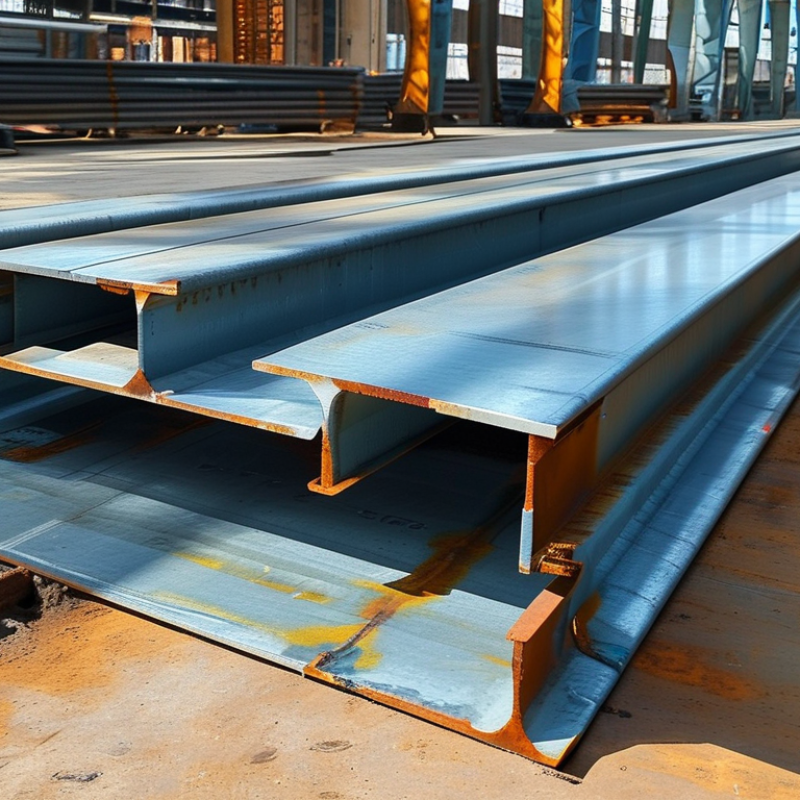
What Is a Galvanized Steel I Beam?
A galvanized steel I beam is a structural beam shaped like the letter “I.” Its vertical web carries shear forces, while its horizontal flanges resist bending. The steel core provides strength, and a zinc coating helps protect it from moisture, oxygen, and salt exposure. In many projects, galvanizing uses a controlled hot-dip process. The beam is immersed in molten zinc, creating a durable metallurgical bond. This protection can extend service life in bridges, warehouses, ports, and outdoor platforms.
For global projects, galvanized I beams offer practical value. They reduce repainting work and support more predictable maintenance planning. Their familiar profile also simplifies design calculations and installation. However, coating thickness, drainage details, transport damage, and local structural codes still require professional review. Galvanizing is not a perfect shield. Cut edges, weld areas, and trapped water may need additional treatment. Site experience often reveals small problems that drawings miss.
Tips: Confirm the beam grade, dimensions, coating standard, and inspection records before shipment. Keep beams dry during storage, and separate them with spacers for airflow. Avoid dragging them across rough surfaces. Check connections carefully, especially where bolts, welds, or dissimilar metals meet. A qualified engineer should verify load capacity, corrosion conditions, and regional requirements. Small documentation gaps can become costly delays across borders.
| Data Dimension | Typical Information | Project Relevance |
|---|---|---|
| Product Definition | A galvanized steel I beam is an I-shaped structural steel section protected by a zinc coating, commonly applied through hot-dip galvanizing after fabrication. | The I-shaped geometry provides efficient resistance to bending, while the zinc coating helps protect exposed steel surfaces from atmospheric corrosion. |
| Structural Geometry | The section consists of two flanges connected by a central web. Flanges mainly resist bending stresses; the web primarily transfers shear and maintains the spacing between flanges. | The geometry offers a high strength-to-weight ratio for beams, platforms, frames, supports, bridges, and industrial structures. |
| Common Steel Grades | Structural grades vary by specification and market. Common minimum yield-strength levels include approximately 235 MPa, 275 MPa, 345 MPa, and 355 MPa. | Designers should select the grade according to the governing structural standard, loading conditions, welding requirements, and local material availability. |
| Zinc Coating Method | Hot-dip galvanizing immerses prepared steel in molten zinc, producing a metallurgically bonded zinc-iron coating. | The process covers external surfaces and many edges more consistently than conventional paint application, provided the member is properly vented and drained. |
| Typical Coating Thickness | For structural steel thicker than 6 mm, ISO 1461 specifies a minimum average coating thickness of 85 micrometres and a minimum local thickness of 70 micrometres for fabricated articles. | Actual requirements depend on the selected coating standard, steel thickness, surface condition, chemistry, inspection method, and project specification. |
| Corrosion Protection | Zinc protects steel through barrier protection and sacrificial or galvanic action. In many outdoor environments, the coating develops a stable protective patina over time. | This can reduce routine repainting and maintenance compared with unprotected carbon steel, although service life depends on the environment and coating thickness. |
| Approximate Density | Steel has a density of approximately 7,850 kg/m³. A galvanized member has a slightly higher mass because of the zinc coating. | Structural calculations, lifting plans, transport documents, and foundation loads should use the actual calculated or certified mass of the finished member. |
| Dimensional Availability | I-beam depth, flange width, web thickness, flange thickness, length, and mass per metre vary by regional section series and applicable standards. | Before procurement, confirm section designation, tolerances, straightness, hole locations, cut lengths, and compatibility with local design codes. |
| Typical Applications | Common applications include exterior building frames, mezzanines, equipment supports, walkways, industrial platforms, agricultural structures, warehouses, and infrastructure components. | Galvanized I beams are particularly useful where members are exposed to rain, humidity, condensation, or intermittent wetting. |
| Environmental Suitability | Suitability depends on atmospheric exposure, humidity, chloride concentration, sulfur compounds, temperature, abrasion, and contact with other materials. | Marine, heavily industrial, buried, immersed, or chemically aggressive conditions may require duplex protection, additional design measures, or a project-specific corrosion assessment. |
| Fabrication Considerations | Vent and drain holes may be required in hollow or enclosed portions. Welding, cutting, drilling, and grinding can locally remove zinc and require approved repair procedures. | Plan fabrication details before galvanizing to minimize distortion, trapped solutions, uncoated areas, and post-treatment repairs. |
| Inspection Criteria | Inspection may include visual appearance, coating thickness measurement, dimensional checks, surface condition, adhesion-related requirements, and verification against the specified standard. | Consistent inspection records support international quality control, acceptance documentation, and traceability without relying on a particular supplier or brand. |
| Global Project Advantage | Galvanized I beams combine a standardized structural form with factory-applied corrosion protection and broad compatibility with international steel design practices. | They can simplify maintenance planning and improve durability, provided the section, steel grade, coating standard, and installation details are coordinated with local regulations. |
| Technical note: The values shown are general engineering reference data. Final beam selection must be verified using project loads, span, restraints, connection design, local standards, corrosion category, and certified material documentation. | ||
How the Galvanizing Process Protects Structural Steel
Galvanized steel I beams suit global projects because galvanizing protects structural steel before harsh conditions begin. The process starts with degreasing, which removes oil, dust, and fabrication residue. Pickling then removes rust and mill scale from the surface. After fluxing, the prepared beam enters a bath of molten zinc, usually near 450°C. Steel and zinc react, forming tightly bonded alloy layers. A final zinc layer creates a continuous barrier against water and oxygen. These layers protect exposed surfaces, corners, and edges more effectively than ordinary paint. That bond matters.
On a coastal project, salt spray can reach steel through tiny scratches. Zinc provides sacrificial protection, corroding before the underlying steel does. In field inspections, coating thickness is checked at several locations, not only on flat faces. Weld zones, bolt holes, and beam ends deserve extra attention. Poor drainage can trap water inside connections and shorten service life. Galvanizing is not magic. A careless design can still create hidden corrosion points. Vent and drain holes help molten zinc flow through enclosed sections safely. Damaged areas after transport may need compatible repair treatment. Engineers should also consider connection details, lifting marks, and local environmental exposure before specifying the process. A small oversight here can become expensive maintenance later.
Why I Beams Support Diverse Global Construction Needs
Why Choose Galvanized Steel I Beam for Global Projects?
Galvanized steel I beams support diverse construction needs because their shape carries heavy loads efficiently. The flanges resist bending, while the web helps transfer shear through the structure. This balance suits warehouses, pedestrian bridges, equipment platforms, and multi-story frames. In coastal towns, zinc protection can slow corrosion caused by salt-laden air. In humid regions, it reduces maintenance pressure around exposed steelwork.
Practical project experience also shows the value of consistent fabrication. I beams can be cut, drilled, and connected before shipment, reducing site labor in remote locations. Their predictable dimensions simplify design coordination across different contractors and construction methods. Engineers still need verified load calculations, suitable connection details, and compliance with local structural standards. Seismic movement, fire performance, drainage, and transport limits cannot be treated as minor details.
Galvanizing is helpful, not magical. A damaged coating near a field-cut edge may need proper repair. Trapped water can also create problems beneath overlapping components. Inspectors should check coating coverage, beam straightness, weld quality, and material certificates. Small errors matter. A beam may appear sound while an unsuitable connection weakens the entire assembly. Project teams should consider climate data, available lifting equipment, and local repair skills before selecting the section. That extra review often prevents expensive changes after delivery.
Key Design Standards and Selection Factors for International Projects
Why Choose Galvanized Steel I Beam for Global Projects?
Key Design Standards and Selection Factors for International Projects
Galvanized steel I beams support global projects when designers control both structural performance and corrosion exposure. Their zinc coating protects exposed steel during transport, installation, and service. However, coating alone does not replace sound engineering.
Start with the project’s governing design code. European projects may follow Eurocode 3, while other regions use national steel standards. ASTM A6 can guide dimensional requirements, and ISO 1461 defines hot-dip galvanized coating expectations. Local rules should control load combinations, seismic resistance, fire design, and connection details. Do not mix values from different standards without engineering review.
Load paths matter. Confirm bending, shear, buckling, deflection, and connection capacity for every beam. Check the clear span, support condition, lifting points, and temporary construction loads. Small errors become expensive later. Details matter.
Select the section by strength, weight, availability, and fabrication limits. A deeper beam may reduce deflection but increase transport difficulty. Galvanizing also affects vent holes, drainage paths, weld access, and final dimensions. Provide suitable openings in closed areas before treatment. Poor detailing can trap chemicals or create uncoated surfaces.
Assess the environment using exposure data, such as humidity, coastal salt, industrial pollutants, and temperature changes. ISO 12944 may help classify atmospheric corrosivity, but site evidence remains valuable. Inspect coating thickness, visual uniformity, cut edges, and repaired areas after delivery. I have seen schedules fail because inspection was treated as paperwork. Allow for uncertainty. A qualified local engineer should verify the final selection, especially where seismic, fire, or unusual corrosion conditions apply.
How to Source, Install, Inspect, and Maintain Galvanized I Beams
Global projects often face rain, salt air, dust, and uneven maintenance practices. Galvanized steel I beams offer practical corrosion resistance when the coating suits the exposure. The real advantage depends on controlled sourcing, careful handling, and documented inspections.
Specify the beam size, steel grade, design load, connection details, and required zinc coating before requesting quotations. Ask for mill certificates, coating records, dimensional reports, and heat or batch traceability. Check that the supplier understands the project’s local structural requirements. A low price can hide thin coatings, poor packaging, or inconsistent dimensions. That mistake becomes expensive offshore.
Inspect delivered beams for white storage staining, bare spots, distortion, and damaged edges. Use a calibrated coating-thickness gauge at several locations, not just one convenient surface. During installation, keep members off wet soil and use padded lifting equipment. Avoid dragging beams across concrete. Drill or cut only according to approved drawings, then repair exposed steel with a compatible zinc-rich system. Keep water from collecting inside connections. Small gaps matter.
After installation, record photographs, bolt conditions, coating readings, and repair locations. Inspect high-risk areas after storms, construction changes, or unusual chemical exposure. Wash salt deposits with clean water when practical, and remove trapped dirt from ledges. Look closely at welds, beam ends, base plates, and drainage points. Maintenance plans often assume perfect access. They rarely have it. Reconsider the inspection frequency when site conditions change, because a sound coating can still fail around damaged details.
