What is an Industrial Network Switch and How Does It Work?
In the world of industrial automation, the role of an industrial network switch is critical. Experts like John Smith, a renowned specialist in industrial networking, emphasize its importance by stating, "An industrial network switch can make or break your factory's efficiency." These devices streamline communication between machinery, sensors, and control systems. They enhance data transmission, enabling quick and reliable connectivity.
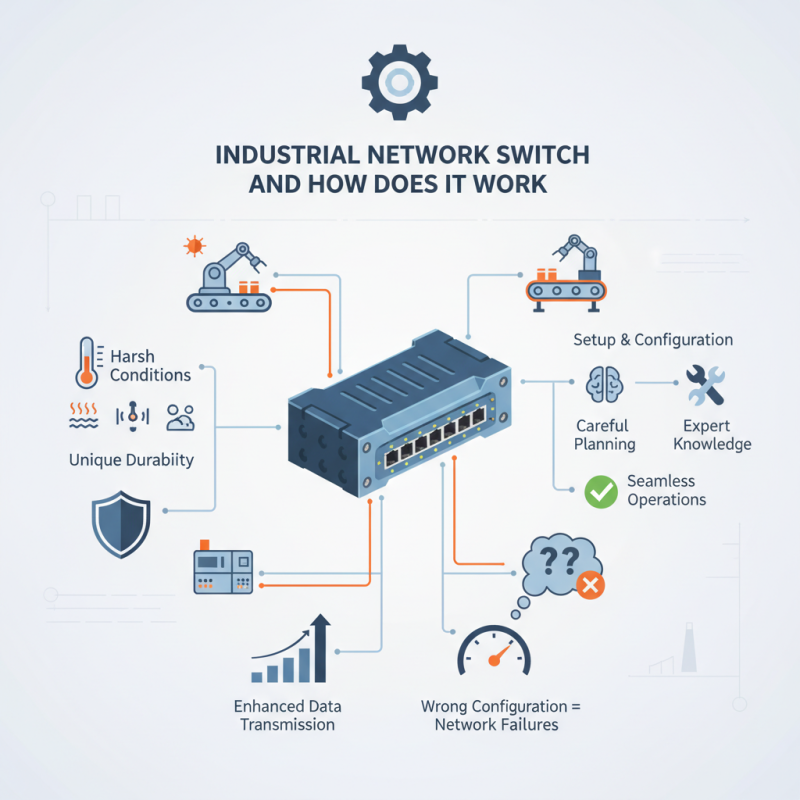
As industries push towards more interconnected systems, the need for robust solutions grows. An industrial network switch typically operates under harsher conditions, unlike standard switches. They endure temperature fluctuations, vibrations, and dust. This unique durability is essential for maintaining seamless operations in factories. However, users often overlook the setup and configuration intricacies.
Understanding the functionality of an industrial network switch is vital. Many may assume integrating such a switch is easy. In reality, it requires careful planning and expert knowledge. The wrong configuration can lead to inefficiencies or even network failures. Reflection on these details is crucial for factory managers aiming for optimal productivity.
What is an Industrial Network Switch?
An industrial network switch is a specialized device designed to facilitate communication between devices in industrial environments. These switches are crucial in factory automation, where reliable data transmission is essential. According to a report by MarketsandMarkets, the industrial Ethernet switch market is projected to grow from $1.83 billion in 2020 to $4.48 billion by 2025. This highlights the growing importance of industrial network switches.
These switches can operate effectively in harsh conditions. They often possess features such as wine temperature ranges, surge protection, and robust enclosures. Typical operational temperatures can range from -40°C to 75°C. Their ability to function in extreme environments is vital for applications such as oil and gas, manufacturing, and transportation. However, installations can be challenging. Proper configuration is often overlooked, leading to potential network downtimes.
Security is another concern. Industrial network switches can be vulnerable to cyberattacks. The increasing interconnectivity of devices means that protecting these systems is crucial. A recent survey indicated that 60% of organizations experienced a cyber incident due to operational technology (OT) vulnerabilities. Regular updates and monitoring are necessary. Yet, many companies hesitate to invest. The consequences can be severe, impacting safety and efficiency.
Key Features of Industrial Network Switches
Industrial network switches serve as the backbone of modern industrial communication. They facilitate data transfer between various machines and devices in sectors such as manufacturing, utilities, and transportation. Key features of these switches greatly enhance their effectiveness in demanding environments.
One critical feature is ruggedness. Industrial switches are often designed to withstand extreme temperatures, vibrations, and other harsh conditions. According to a recent industry report, up to 70% of equipment failures in industrial settings are due to environmental stressors. Additionally, they offer reliable redundancy options. This ensures continuous operation even during equipment failures, which is vital for critical applications.
Another important aspect is security. As industrial environments increasingly connect with IoT technologies, the need for robust security measures grows. Advanced industrial switches include capabilities like VLAN support and traffic filtering. Recent statistics indicate that nearly 30% of cyberattacks target the industrial sector. Therefore, implementing layered security strategies is essential. Despite these advancements, many facilities still struggle with outdated infrastructure, leaving them vulnerable. Organizations must engage in continuous monitoring and improvement to keep up.
Key Features of Industrial Network Switches
How Industrial Network Switches Operate
Industrial network switches are essential for robust communication within industrial environments. They connect various devices like sensors, controllers, and machinery. This networking enables real-time data exchange. For instance, in a factory setting, an industrial switch can link machines to a centralized control system. This setup ensures seamless operation, but it comes with challenges.
The main function of an industrial network switch is to route data packets efficiently. It inspects incoming data and decides the best path for transmission. Each port on the switch can connect different devices, allowing for modularity. However, this flexibility sometimes leads to excessive complexity. Troubleshooting can become cumbersome if there are too many connected devices. The switch must also adapt to harsh conditions, like extreme temperatures and vibrations.
Many industrial switches support Power over Ethernet (PoE). This feature simplifies wiring by delivering power alongside data through the same cable. It reduces clutter but increases dependency on the switch's reliability. What happens if the switch fails? This reliance can be a double-edged sword. Maintenance becomes crucial, yet often overlooked in busy settings. Balancing efficiency and simplicity is key in managing industrial networks.
What is an Industrial Network Switch and How Does It Work?
| Feature | Description | Functionality |
| Type | Managed/Security | Provides control over network traffic |
| Port Count | 8, 16, 24, 48 Ports | Allows multiple devices to connect |
| Communication Type | Ethernet, Fiber Optic | Supports various communication protocols |
| Industrial Standards | IP30/IP67 | Ensures protection against environmental factors |
| Operating Temperature | -40°C to 75°C | Suitable for harsh industrial environments |
| Power Supply | Dual Power Inputs | Ensures high availability of network services |
| Management Features | SNMP, VLAN, QoS | Optimizes performance and security |
Comparing Industrial Network Switches to Commercial Switches
Industrial network switches and commercial switches serve similar purposes, yet they differ significantly in performance and functionality. According to a recent report by MarketsandMarkets, the industrial Ethernet switch market is expected to reach over $3 billion by 2026, reflecting its increasing importance. Industrial switches are built to endure harsher environments. They can operate in extreme temperatures, humidity, and dust compared to their commercial counterparts. However, many users underestimate the need for these capabilities.
While commercial switches handle standard office tasks well, they often falter in industrial settings. For example, commercial switches may not support real-time data processing. This is crucial for automation systems found in manufacturing. Moreover, industrial switches typically offer better redundancy features. This helps maintain network uptime, vital in mission-critical operations. A network failure can lead to substantial downtime and losses.
Additionally, industrial switches usually have more security features than commercial switches. With cyber threats on the rise, factory networks are ripe for attacks. A study by Cybersecurity Ventures estimated that cybercrime damages will reach $10.5 trillion annually by 2025. It's crucial for industries to reflect on their network setups and consider robust solutions. Transitioning from commercial to industrial can be daunting, but the benefits often outweigh the challenges. It’s essential to be proactive and evaluate network needs comprehensively.
Applications of Industrial Network Switches in Various Industries
Industrial network switches are vital components in many sectors. They ensure seamless communication between devices. Commonly, these switches find applications in manufacturing, transportation, and smart grids.
In manufacturing, industrial network switches facilitate real-time data transfer between machines. They connect sensors, controllers, and servers, enabling automation. This improves efficiency and reduces downtime. However, choosing the right switch can be challenging. Not every switch suits all environments. Factors like temperature and vibration matter.
In transportation, these switches help monitor vehicle performance. They connect various systems, allowing quick responses. For instance, in a smart traffic system, they enable timely communication to reduce congestion. Yet, the complexity of these systems can lead to potential issues. Testing is crucial before deployment.
Tips: Always assess your specific environment before selecting a switch. Pay attention to compatibility with existing equipment. Regularly review network performance to identify areas for improvement.