
Quality Products

At a Fair Price

Wholesale Provider

Of Valves & Fittings

  • Corporate Office: 1301 Greengrass Drive Houston, TX 77008
  • 1-800-237-2512

Quality Products

At a Fair Price

Wholesale Provider

Of Valves & Fittings

What Are the Top HDPE Welding Equipment Types in 2026?

Hdpe Welding Equipment in 2026 spans several distinct tools, each suited to particular pipe sizes, job-site conditions, and production demands. Butt fusion machines join pipe ends with controlled heat and pressure. Electrofusion units use fittings with embedded heating elements, while extrusion welders and hot-air tools support fabrication and repair work. The right choice depends on more than machine type. Pipe diameter, material compatibility, operator skill, and access to stable power all matter.

A field-ready setup is easy to picture: clean pipe ends, aligned clamps, a calibrated heater plate, and enough room to handle long sections safely. Small details can change the result. A rushed temperature check or poor alignment may leave a joint that looks sound but needs closer inspection. Equipment alone does not guarantee a reliable weld.

I can’t verify a named expert’s published statement from the material provided, so I won’t present an invented quotation as fact. A useful guiding principle for this overview is: “Choose the welding process to fit the joint, the site, and the quality checks you can perform.” The sections that follow compare the leading HDPE Welding Equipment types and explain where each can be useful—and where a closer look is still needed.
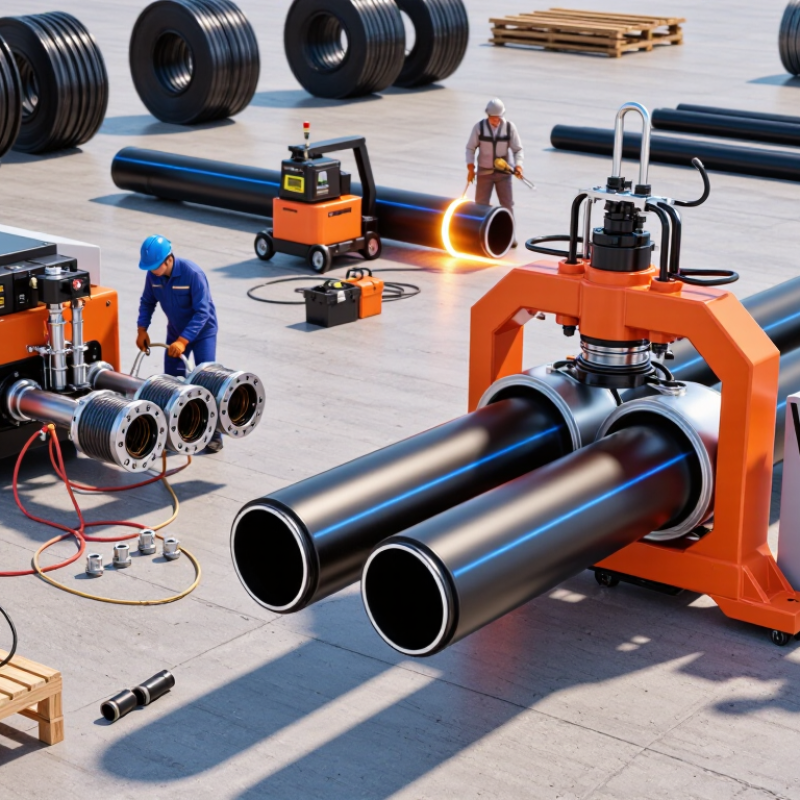
What Are the Top HDPE Welding Equipment Types in 2026?

HDPE Welding Equipment: Purpose and Operating Principles

HDPE welding equipment joins thermoplastic pipes, sheets, and fittings into continuous, leak-resistant systems. Its purpose is practical: create strong joints for water networks, drainage, industrial lines, and protective liners. In 2026, common equipment types include butt fusion machines, electrofusion tools, extrusion welders, and hot-air welders. Each type suits different shapes, thicknesses, and site conditions.

Butt fusion machines heat two prepared pipe ends with a flat plate. The softened surfaces are pressed together under controlled pressure and cooling time. Alignment matters greatly. Even a small offset can weaken the joint or reduce flow inside the pipe. Electrofusion equipment uses fittings containing embedded heating wires. An electrical current melts the fitting and pipe surface, forming a sealed connection around the joint.

Extrusion welders feed heated HDPE rod into a prepared seam. They are useful for tanks, sheets, and complex repairs. Hot-air welders soften surfaces before controlled pressure is applied. Operators must clean, scrape, and dry the joint before heating. Dust, moisture, and unstable temperatures can cause hidden defects.

The process looks simple.

It is not flawless.

Experienced technicians inspect bead shape, fusion pressure, temperature records, and cooling time. Visual checks help, but they cannot reveal every internal weakness. I have found that rushed preparation creates more failures than inadequate heating. Still, equipment readings can drift, and field conditions remain unpredictable. Regular calibration, test coupons, and documented procedures make results more dependable.

Butt Fusion Machines for Joining Large-Diameter Pipes

For large-diameter HDPE pipe, butt fusion machines create a joint by heating aligned pipe ends and pressing them together under controlled pressure. The machine’s frame and clamps must hold heavy sections steady; even slight movement can affect alignment. On site, crews often check that pipe ends sit level before facing them. Small gaps matter.

A typical setup includes a facing tool, a heated plate, hydraulic controls, and clamps sized for the pipe. The facing tool creates smooth, parallel ends. The plate heats them evenly, then operators join the softened surfaces using the specified pressure and cooling time. Temperature, drag pressure, and pipe movement should be monitored, not guessed. A visible, even bead can help identify problems, but it does not prove the joint is sound by itself.

Large machines need room and careful handling. Mud, wind, or a cold pipe surface can complicate preparation, while rushed cooling may weaken a joint. One practical detail is easy to overlook: keep the heater plate clean and protect prepared ends from dust. Records of machine settings and joint conditions support later review. They are not magic, though; poor alignment still needs correction. Not every bead looks textbook-perfect. A qualified operator should assess irregularities against the applicable joining procedure before the pipeline moves on.

What Are the Top HDPE Welding Equipment Types in 2026?

Typical pipe outside-diameter coverage varies by equipment model and system.

Butt fusion machines are widely used for joining large-diameter pipes. The ranges shown are indicative, not universal specifications; check the machine and fitting system requirements for actual capacity.

Electrofusion Units for Precise, Compact Pipe Connections

Electrofusion units are suited to compact, precise connections where large butt-fusion machines are awkward, such as repair pits and crowded service corridors. A typical unit controls the fitting’s heating cycle and may store fusion records, including cycle time and voltage. Installers can compare these values with the fitting’s specified parameters instead of relying on memory.

Technical guidance matters as much as the machine. ISO 12176-2:2008 sets requirements for electrofusion equipment, while the Plastics Pipe Institute’s Handbook of Polyethylene Pipe describes electrofusion joining practices such as cleaning, scraping, and alignment. These steps remove surface contamination and help keep the pipe steady during heating and cooling. Small errors count.

A compact unit does not make a joint foolproof. A rushed scrape is easy to underestimate, and a perfect-looking record cannot prove that the pipe surface was properly prepared. Keep the unit dry, protect leads from damage, and record job conditions alongside fusion data. That record helps crews investigate inconsistent results later, though it cannot replace careful inspection.

What Are the Top HDPE Welding Equipment Types in 2026? - Electrofusion Units for Precise, Compact Pipe Connections

Equipment type Joining method Typical work range Power and process control Portability Best suited to
Electrofusion control unit Heats the embedded resistance wires in an electrofusion fitting to fuse it to a prepared pipe surface. Commonly 20–630 mm fitting diameters; supported range depends on the unit and fitting system. Typically powered by 110 or 230 V AC; many units read fitting data and regulate the weld cycle automatically. Compact and job-site portable; heavier-duty units may require a trolley or vehicle transport. Precise, compact connections, repairs, service connections, and locations with limited room for larger machines.
Butt fusion machine Heats pipe ends with a plate and presses them together under controlled alignment and force. Equipment is available for pipe diameters from around 40 mm to 1,600 mm and larger, depending on machine class. Manual or hydraulic clamping; temperature-controlled heater plates are typical. Small models can be carried; large-diameter machines are generally trailer- or excavator-supported. Long, straight pipeline runs and larger-diameter pipe joints where there is space to align and clamp the pipe.
Socket fusion tool Heats the pipe exterior and fitting interior on matching dies before the parts are joined. Commonly used for small-diameter pipe, often about 20–125 mm; the tool and fitting system set the limit. Electric heater with temperature control; dies are selected to match pipe and fitting size. Lightweight and easy to use in confined spaces. Small-bore plumbing, branch connections, and workshop or indoor installation work.
Extrusion welder Feeds molten thermoplastic filler into a prepared joint while hot air or another heat source warms the surfaces. Used for fabrication and repair of thick sections, fittings, tanks, and large pipe components; capacity varies by model. Typically electrically heated; models vary in output rate, filler size, and temperature control. Portable handheld models are available, though some are bulky for overhead or confined work. Fabrication, repair patches, and joints that are unsuitable for standard butt fusion.
Hot-air welder Directs heated air at the joint, often with a separate filler rod and a suitable welding nozzle. Primarily for thin sheet, liners, and light fabrication rather than pressure-pipe butt joints. Temperature and airflow are adjustable on many tools; settings must suit the material and application. Handheld and highly portable. Geomembranes, sheet fabrication, and small repair tasks where a hot-air process is appropriate.
Pipe scraper and alignment clamps Prepares the pipe surface and holds pipe and fitting in alignment; these are supporting tools, not welding heat sources. Tool sizes are selected to match the pipe diameter and joint configuration. Usually manual; scraping depth, clean surfaces, and stable alignment are important for electrofusion preparation. Generally compact and portable. Essential preparation and restraint for repeatable electrofusion joints and many repair connections.

Note: Work ranges and electrical requirements are typical examples, not universal specifications. Always follow the pipe, fitting, and equipment instructions for the selected joining procedure.

Extrusion and Socket Fusion Tools for Specialized Applications

Extrusion and socket fusion tools serve different HDPE jobs. Extrusion welders suit tanks, liners, and large fittings where a continuous bead joins prepared surfaces. Operators control hot-air temperature, feed speed, and bead pressure. A visible, even bead helps, but it does not prove a sound weld. Surface preparation and compatible filler material matter just as much.

Socket fusion tools fit smaller pipe connections and confined installations. A heated socket and spigot soften matching surfaces before the parts are pressed together. ASTM F2620-20 sets out procedures for socket fusion, including heating and cooling controls; its guidance makes clear that timing depends on pipe dimensions and material conditions.

No guesswork.

In the field, technicians should use calibrated heaters, clean facing tools, and a stable work surface. The Plastics Pipe Institute’s Handbook of Polyethylene Pipe also describes fusion as a process requiring controlled alignment and joint preparation. That practical detail is easy to overlook when work moves quickly. One imperfect habit: crews sometimes judge readiness by appearance alone. Better to record temperatures, times, and operator checks for each joint.

How to Choose HDPE Welding Equipment for 2026 Projects

Choosing HDPE welding equipment starts with the joint, pipe size, and jobsite conditions. Butt-fusion machines suit long, straight runs and larger diameters; electrofusion tools help where access is tight or fittings are complex. Socket-fusion equipment fits smaller pipe, while extrusion welders are used for sheet and fabricated components. More capability is not always better. A machine that is awkward to move can slow a crew on a narrow trench.

Check the procedure before buying or renting. ASTM F2620 covers heat-fusion joining of polyethylene pipe and fittings, while ISO 21307 describes butt-fusion procedures. Match the machine’s size range and heating capacity to the project specification. Look for stable clamping, accurate temperature control, readable pressure settings, and recorded weld data. Small errors matter. A clean-looking bead alone does not prove a sound joint.

Project demand also matters. The U.S. EPA’s 2023 Drinking Water Infrastructure Needs Survey and Assessment estimated $625 billion in drinking-water infrastructure needs over 20 years. That scale makes repeatability and maintenance worth weighing alongside purchase price. Ask whether the equipment can be calibrated, serviced locally, and operated by trained staff. Check power supply and weather protection on site, too. I would not treat a digital display as a substitute for procedure checks; that assumption is easy to make, and easy to regret.

Top
error: Content is protected !!